A new Coventry sci-fi defence research project is helping the Ministry of Defence explore how future technologies could reshape global security over the next century.
Dr Allen Stroud, from Coventry University’s Research Centre for Peace and Security, has worked with the Defence Science and Technology Laboratory (dstl) to develop Creative Futures. This initiative brings together science fiction writers and defence experts to imagine scenarios as far ahead as 2122.
As emerging technologies evolve rapidly, traditional forecasting methods often struggle to keep pace. Therefore, the project uses storytelling to explore long-term risks, opportunities and human impacts in a more flexible way.
Coventry Sci-Fi Defence Research Explores Future Threats
The Coventry sci-fi defence research programme focuses on how technologies such as artificial intelligence, quantum computing and autonomous systems could shape future conflict.
For example, some stories explore wars fought by autonomous machines. Others examine how quantum technology might predict future events or how AI systems could make life-and-death decisions. Consequently, these narratives highlight both technological potential and ethical risk.
Dr Stroud explained that science fiction offers more than entertainment. Instead, it acts as a strategic tool that helps policymakers and researchers test ideas beyond current constraints. By doing so, it allows organisations to anticipate challenges that may not yet be visible.
Importantly, the stories avoid rigid predictions. Rather than focusing on fixed outcomes, they explore how people might respond to future crises. For instance, one scenario imagines a climate-related emergency in a coastal city, while another examines evolving forms of terrorism. As a result, the project builds adaptable thinking rather than narrow forecasts.
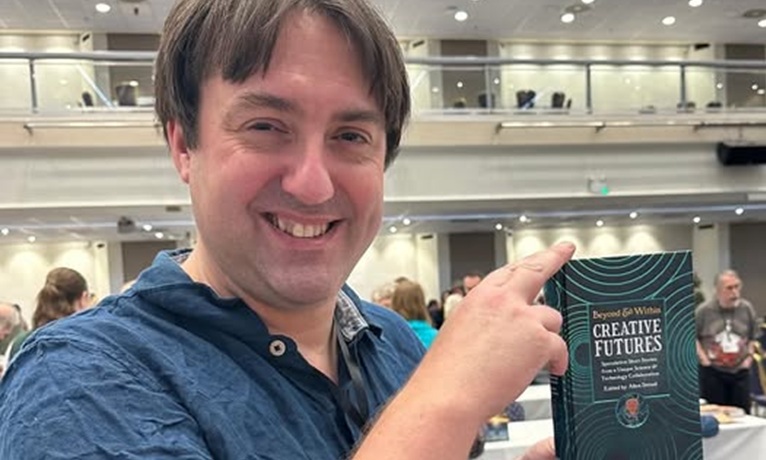
Photo: Dr Allen Stroud, Photo Credit: Coventry University
Bridging Creativity and Defence Innovation
The collaboration between Coventry University and dstl reflects a broader shift toward interdisciplinary innovation. Increasingly, defence and security organisations are combining technical expertise with creative thinking to improve long-term planning.
Sarah Herbert, dstl Futures Programme Manager, said:
Preparing for the future requires looking beyond immediate system upgrades. Instead, organisations must consider the wider human, societal and geopolitical impact of technology.
This approach aligns with wider UK innovation efforts. For example, national AI investment programmes aim to strengthen long-term research capability while addressing real-world challenges. At the same time, regional innovation ecosystems continue to contribute to emerging technologies and strategic thinking.
From Imagination to Real-World Impact
Although the project uses fictional narratives, its purpose remains practical. By exploring extreme or unexpected scenarios, researchers can identify gaps in current planning and improve resilience strategies.
Therefore, the Coventry sci-fi defence research initiative demonstrates how creative methods can support serious policy development. In turn, it highlights the growing role of universities in shaping national security thinking.
Overall, as global risks become more complex, combining imagination with scientific expertise may prove essential. By thinking beyond the present, organisations can better prepare for the challenges of tomorrow.
To find out more about advanced engineering innovation in the West Midlands, read our coverage on Birmingham Deep-Sea Inspection Robot Targets Offshore Safety.